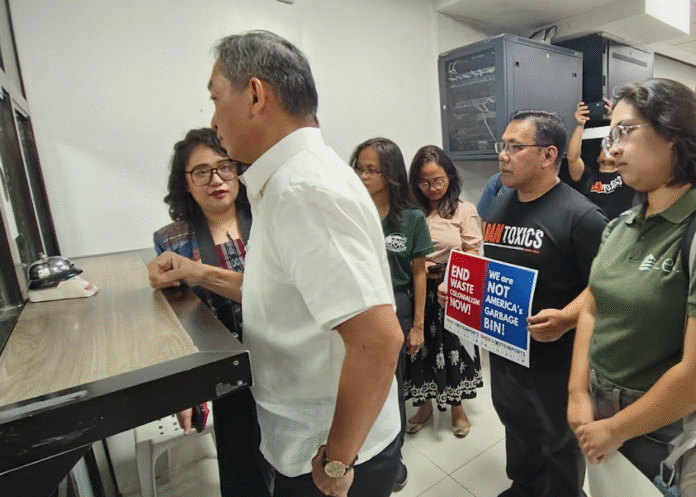
ENVIRONMENTAL advocates and progressive lawmakers are demanding an urgent congressional inquiry into the arrival of hundreds of shipping containers filled with suspected hazardous electronic waste (e-waste) from the United States.
The groups warn that regulatory loopholes are turning the country into a dumping ground, threatening public health and local ecosystems.
Led by the Task Force END E-WASTE IMPORTS, a coalition of ecological watchdogs, advocates have thrown their full support behind House Resolution No. 1164. Filed by the MAKABAYAN Bloc, the resolution urges the House of Representatives to conduct an immediate investigation in aid of legislation regarding 234 containers of suspected hazardous e-waste and one container of plastic waste currently held at the Subic Bay Freeport Zone.
According to the global waste trade watchdog Basel Action Network (BAN), its monitoring campaign, Operation Can Opener, successfully traced the toxic cargo back to the United States.
BAN has issued 14 separate alerts to Philippine authorities regarding these illegal shipments since March 2025.
Despite these warnings, national environmental and border authorities have been unable to intervene.
Enforcement has been gridlocked by an April 2025 Manila Regional Trial Court ruling, which upheld the Subic Bay Freeport Zone’s status as a separate customs territory.
The decision effectively allows unimpeded e-waste imports, severely undermining the regulatory power of the Bureau of Customs (BoC) and the Department of Environment and Natural Resources’ Environmental Management Bureau (DENR-EMB).
To underscore the severity of the situation, the task force recently released aerial footage displaying massive piles of electronic scrap and toxic ash accumulating from ongoing e-waste processing inside Subic.
The Subic Bay Metropolitan Authority (SBMA) defended the shipments, stating the materials are meant for commercial recycling rather than dumping. However, the task force strongly rejects this justification.
Under the Basel Convention, an international treaty ratified by the Philippines in 1993, importing hazardous waste from a non-party state for recycling is strictly prohibited. The United States is not a party to the convention.
Furthermore, Article 4 of the treaty explicitly labels unauthorized transboundary movements of hazardous waste as criminal.
While exceptions exist under Article 11 if a public bilateral agreement is active, no such agreement between the U.S. and the Philippines has been made available to the public.
“Whether it’s for recycling or dumping, those are hazardous waste,” Dizon emphasized. “Those are e-waste from developed countries who exploit our cheap labor and regulatory loopholes, shifting their own waste burdens to countries such as ours. May pera sa basura, pero may lason din sa basura (There is money in trash, but there is also poison in trash).”
Under DENR Administrative Order No. 2013-22, e-waste is legally classified as hazardous. Exporting nations are required to obtain Prior-Informed Consent (PIC) from the Philippine government before shipping.
Advocates argue that SBMA is circumventing these controls, noting that during recent legislative deliberations, the authority even expressed intentions to explicitly exempt freeports from the Basel Convention.
Lawmakers are now framing the dispute as a battle over national sovereignty. Citing the 1987 Constitution and Republic Act No. 6969 (the Toxic Substances and Hazardous and Nuclear Wastes Control Act), which outright prohibits the entry or transit of toxic waste, officials are calling for swift systemic accountability.
“This is an issue of both national sovereignty and environmental justice,” stated KABATAAN Partylist Representative Renee Co. “Our country must never become a destination for foreign waste at the expense of our people and our environment.”
The proposed congressional probe aims to clarify the jurisdictional conflicts that have paralyzed environmental enforcement, expose accountability lapses among state agencies, and permanently plug the loopholes facilitating illegal waste trade.