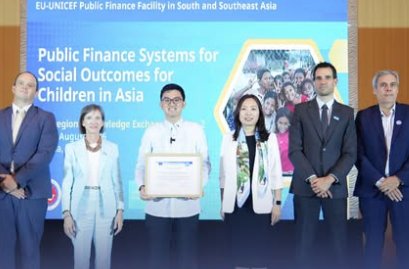
THE Philippines has reaffirmed its leadership in advancing child-responsive public financial management by hosting a regional knowledge-sharing exchange aimed at optimizing public resources for education, nutrition, and social protection despite mounting fiscal and climate pressures.
Organized by the Department of Budget and Management (DBM) in partnership with the European Union (EU) and UNICEF, the three-day South-South Exchange took place from August 18 to 20 under the EU-UNICEF Public Finance Facility.
The conference convened delegates from eight South and Southeast Asian nations: Bangladesh, Bhutan, Mongolia, Nepal, the Philippines, Sri Lanka, Thailand, and Vietnam.
Participating nations addressed a shared challenge across the region: maintaining robust investments in children during periods of tight fiscal constraints and economic shocks.
Delegates reviewed specialized public finance mechanisms designed to enhance budget transparency and efficiency, including expenditure tracking, budget tagging, evidence-based planning, and the Social Sector Dashboard Budget Tracker.
These operational tools enable governments to monitor whether public allocations effectively reach essential child protection, healthcare, and educational programs.
The initiative aligns with the Philippines’ ongoing economic transition toward upper-middle-income status, highlighting the necessity of translating economic growth into sustainable social welfare systems.
“Spending for our children should never be seen merely as a cost,” stated DBM Acting Secretary Kim Robert C. De Leon. “When we invest in a child, the return is measured not only in pesos or percentages, but in healthier lives, better opportunities, stronger communities, and ultimately, stronger nations.”
Kyungsun Kim, UNICEF Philippines Representative, emphasized that stronger public finance frameworks ensure economic progress translates directly into equitable outcomes for vulnerable youth.
Frederic Grillet, Chargé d’Affaires of the EU Delegation to the Philippines, noted that the initiative complements the EU’s Global Gateway Strategy by strengthening governance, human capital, and institutional foundations.
Since its launch in 2019 with a €3-million commitment, the EU-UNICEF Public Finance Facility has provided technical assistance, policy guidance, and analytical tools across the region to ensure public spending remains transparent, accountable, and focused on long-term results for children.