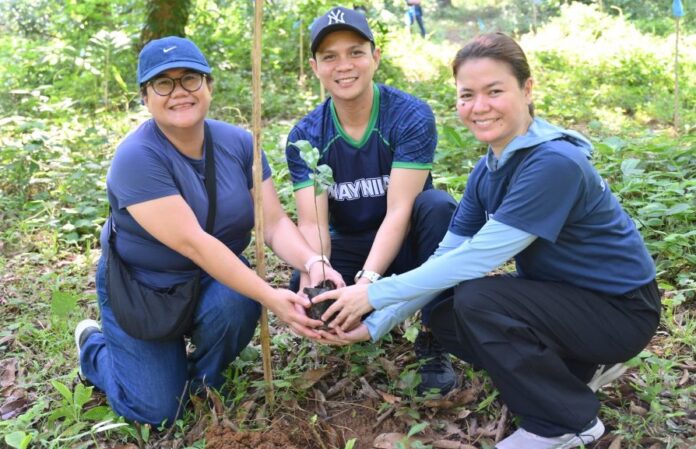
WEST Zone concessionaire Maynilad Water Services, Inc. has officially kicked off its 2026 Plant for Life program, setting a new milestone with its highest annual planting goal to date.
The water utility aims to plant 230,225 indigenous tree seedlings across 450 hectares of priority restoration land within the Ipo Watershed.
Identified in coordination with the Department of Environment and Natural Resources (DENR), the 2026 planting sites span denuded areas in Norzagaray, Bulacan, and Mt. Balagbag in Rizal.
The Ipo Watershed plays a crucial role as part of the Angat-Ipo raw water system, which supplies the majority of Metro Manila’s water needs.
Reforesting these lands helps minimize soil erosion and sedimentation, enhance groundwater infiltration, support local biodiversity, and safeguard the capital’s primary water source.
Unlike typical single-day planting events, Maynilad’s initiative commits to three years of continuous site maintenance.
Partnering with local people’s organizations, community stewards conduct regular monitoring, vegetation management, protection, and replacement planting to ensure high seedling survival.
This sustained approach has enabled the program to maintain an overall seedling survival rate exceeding 85% over the last seven years.
Notably, a 450-hectare site reforested in 2025 achieved a DENR-validated 92.1% survival rate.
“Watershed restoration is measured not only by how many seedlings are planted, but by how many are able to survive and become part of a functioning forest,” said Maynilad Chief Sustainability Officer Atty. Roel S. Espiritu.
“By combining indigenous tree planting with sustained site care and community stewardship, we help strengthen the natural systems that support water quality, water availability, and the resilience of nearby communities,” added Espiritu.
To promote biodiversity and ecological adaptability, native species including narra, kupang, and kalumpit will be planted.
Since its launch in 2007, the ‘Plant for Life initiative’ has planted over 1.64 million seedlings across nearly 2,420 hectares of critical watershed areas.