CYBERCRIME has rapidly escalated into a $15 trillion global challenge, but defeating sophisticated attacks requires looking beyond technical defenses to focus on people, leadership, and cross-sector collaboration.
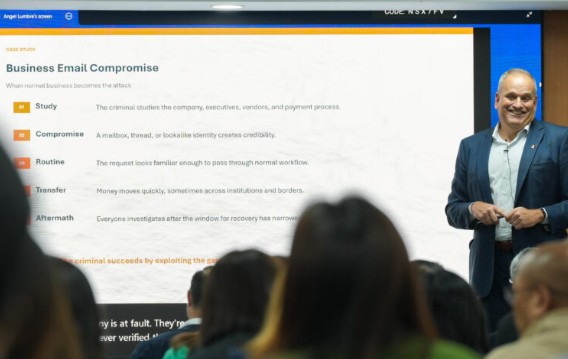
This was the central theme emphasized by retired FBI Supervisory Special Agent Scott Augenbaum during a talk organized by the Asian Institute of Management (AIM) Washington SyCip Graduate School of Business and the U.S. Embassy in Manila.
Addressing professionals and students from banking, technology, law enforcement, and academia, Augenbaum highlighted that the rapid expansion of cyber threats does not leave organizations powerless.
“When I was with the FBI in 2016, I was telling the general public that the cybercrime problem was a $3 trillion problem… Today, the cybercrime problem is probably a $15 trillion global problem,” Augenbaum noted, pointing out that bad actors can strike from anywhere in the world.
Despite the scale of the threat, Augenbaum stressed that effective prevention remains achievable.
Drawing from over three decades of investigating cyber threats, he revealed that nearly 90% of the cases he handled could have been prevented if end-users had possessed a few key pieces of critical information.
While technical infrastructure protects against corporate risks like malware and credential theft, cybercriminals increasingly rely on social engineering to manipulate human behavior.
Because a single compromised credential can trigger severe financial, operational, and reputational damage, cybersecurity must evolve into an organizational leadership discipline rather than remain an isolated technical function.
Programs like AIM’s Executive Master in Cybersecurity Management reflect this shift, integrating cybersecurity into corporate strategy, governance, and management.
By equipping future leaders to bridge the gap between technology and business operations, organizations can build stronger defenses.
Ultimately, Augenbaum underscored that building a resilient cybersecurity ecosystem requires unified action across law enforcement, government agencies, academia, and the private sector.
“It takes a community to be safe,” he stated, reminding the audience that while cybercrime knows no borders, effective defense relies on strong, cross-border partnerships.