



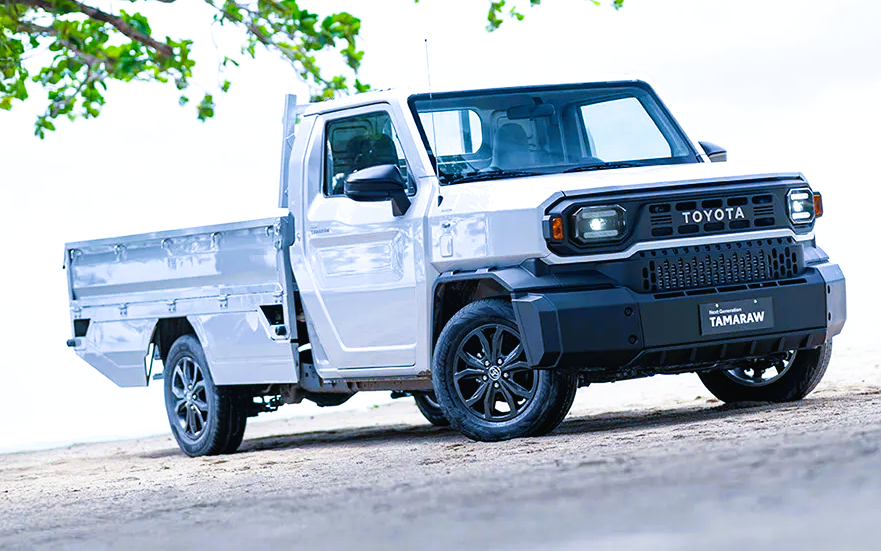


TOYOTA Motor Corp.’s local unit has officially unveiled a modernized iteration of its legendary Tamaraw model, tailored specifically for public transport to capture a vital foothold in the Philippines’ transit modernization market.
The Next Generation Tamaraw has secured official certification from the Department of Transportation as a Class 1 Modern Public Utility Vehicle (MPUV).
This rollout serves as a cornerstone of Toyota Motor Philippines Corp.’s ₱5.5-billion investment initiative, which is dedicated to expanding local assembly, automotive parts localization, and vehicle body conversion at its manufacturing facility in Santa Rosa, Laguna.
By entering the Class 1 MPUV segment, Toyota seeks to support the government’s comprehensive fleet renewal program.
The state initiative aims to phase out aging, high-emission traditional jeepneys—long celebrated as the “king of the road”—and replace them with safer, eco-friendly commercial platforms.
Toyota Motor Philippines President Masando Hashimoto noted that the strategic launch unlocks an unserved segment for the brand within the country’s public transportation network.
By integrating into daily commutes, Hashimoto stated that the Tamaraw evolves into a true national vehicle serving all Filipinos.

To establish operational momentum, Toyota Motor Philippines Chairman Alfred Ty announced an initial production target of roughly 15,000 units per month.
Ty acknowledged that while this is a conservative starting volume, the company is actively engaging fleet and MPUV owners to test and adopt the new offering.
Reflecting strong early execution, Toyota produced 14,711 Tamaraw units through the end of September, bringing cumulative production to 34,739 units since its local introduction two years ago.
The manufacturing push arrives as Toyota looks to rebuild growth following earlier adjustments to annual production targets.
Ty projected a market recovery by 2027, propelled by economic tailwinds, government infrastructure spending, and anticipated election-related financial circulation.
Currently, Toyota maintains a dominant 49 percent share of the Philippine automotive market, according to data from the Chamber of Automotive Manufacturers of the Philippines, Inc.