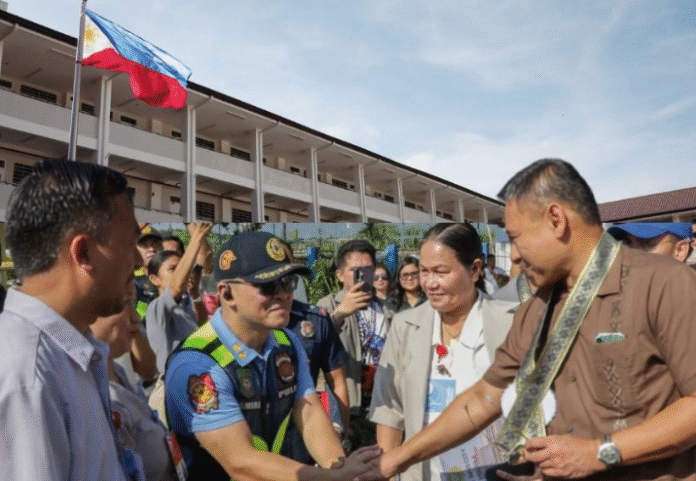
THE Department of Education (DepEd) has unveiled a comprehensive hybrid campus security framework aimed at safeguarding public schools nationwide by optimizing limited fiscal resources through community-level collaboration and modern surveillance technology.
Led by Education Secretary Sonny Angara, the new strategy addresses lingering security guard shortages by deploying a localized allocation system based strictly on enrollment size and specific campus requirements.
The approach bridges operational gaps by coordinating school guards with barangay tanods, Parent-Teacher Association (PTA) volunteers, Philippine National Police (PNP) mobile patrols, and upgraded physical security infrastructure.
“Tulad ng laging paalala ni Pangulong Bongbong Marcos, dapat manatiling ligtas at payapa ang ating mga paaralan bilang mga sentro ng pagkatuto,” Secretary Angara stated, emphasizing that community involvement is vital to maintaining safe learning environments.
“Alam natin ang limitasyon sa ating pondo, kaya hindi natin pwedeng iasa sa iilang security personnel lamang ang seguridad ng buong kampus,” added Angara.
The initiative builds directly upon the Department of the Interior and Local Government (DILG) Memorandum Circular No. 2026-037 on Safer School Zones.
This circular outlines the authorized roles and operational boundaries of local government units (LGUs) and barangay tanods, focusing on perimeter safety, traffic and crowd control, peak-hour monitoring, and swift incident reporting while preserving the primary authority of school administrators.
Under the framework’s tiered allocation model:
- Small and Medium Campuses (up to 1,000 learners): Assigned one security guard, augmented by barangay tanods and PTA volunteers during peak arrival and dismissal hours.
- Large Campuses (1,001 to 3,300 learners): Allocated two security guards alongside LGU watchmen and dedicated PTA assistance teams.
- Very Large and Extremely Large Campuses (3,301 learners and above): Provided four security guards reinforced by PNP mobile patrols and local security officers.
DepEd will execute the nationwide rollout in two phases, prioritizing high-density campuses before extending coverage to small and medium schools.
To strengthen perimeter defenses without increasing personnel costs, the department is concurrently investing in surveillance infrastructure, including closed-circuit television (CCTV) cameras, enhanced lighting, and access control scanners.