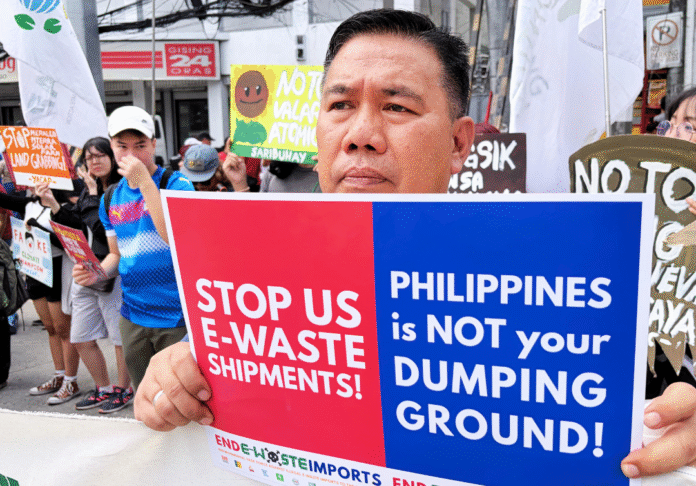
ENVIRONMENTAL watchdog Basel Action Network (BAN) and the local coalition End E-Waste Imports have issued an urgent alert to Philippine authorities regarding 184 shipping containers suspected of carrying illegal electronic waste from the United States.
The shipments are scheduled to arrive at the Subic Bay Freeport Zone between August 6 and September 30, 2026.
The official alert, issued under BAN’s Operation Can Opener, was transmitted on July 29 to Bureau of Customs (BOC) Commissioner Ariel Nepomuceno and Environmental Management Bureau (EMB) Director Michael Drake Matias.
It follows a prior enforcement action on July 22, when BOC Subic District Collector Geniefelle Lagmay ordered three suspect containers declared as “scrap copper” to remain aboard the vessel MV Tokyo Express, citing international treaty obligations and Republic Act 6969.
High Stakes and Regulatory Loopholes
Environmental advocates praised the initial interception but stressed that the upcoming wave of shipments demands immediate, large-scale government action.
“We commend the Bureau of Customs for promptly acting on the prior alert,” said Jam Lorenzo, Deputy Executive Director of BAN Toxics. “But that was three containers. BAN has now identified 184 more suspected containers, and the government must respond with the same urgency and resolve.”
Under the Basel Convention—specifically updated amendments that took effect in January 2025—nearly all electronic waste is strictly controlled. Because the Philippines is a party to the treaty while the United States is not, importing controlled waste without a formal bilateral agreement violates Article 4(5) of the convention.
Both the U.S. Environmental Protection Agency (EPA) and the State Department confirmed to BAN that no such agreement exists with the Philippines.
Demands for Repatriation and Policy Safeguards
Activists are urging Philippine authorities to detain, inspect, and prevent any verified illegal waste from entering local ports. However, environmental leaders warn against simply turning ships away without formal diplomatic mechanisms, as unmonitored shipments are often rerouted to other developing nations.
To prevent this, the task force urges the Philippine government to invoke a 2001 bilateral agreement on hazardous waste moving from the Philippines to the U.S.
“Sending these shipments back informally, container by container, is not enough,” explained Jim Puckett, Founder and Chief of Strategic Direction of BAN. “The existing bilateral arrangement gives the country a lawful path to ensure illegal e-waste is taken back by the US to be responsibly managed and recycled there.”
Concerns Over “Urban Mining” and Future Agreements
The coalition also voiced strong opposition to any potential new bilateral deals that would legalize U.S. e-waste exports.
In particular, groups raised alarms over the proposed U.S.-led Pax Silica Initiative, an initiative intended to establish an artificial intelligence industrial hub and critical mineral processing in the Philippines.
Activists cautioned that without strict oversight, frameworks around “urban mining” and critical mineral recovery could be exploited as a legal loophole for dangerous e-waste dumping.